Assessing The Socio-Economic Effects of Banditry on Households in Maru LGA, Zamfara State, Nigeria

Authors

Keywords:

Banditry, Socio-economic Impacts, Households, Maru LGA, Zamfara State

Abstract

Banditry has emerged as severe security challenges in Northwest Nigeria, with Zamfara State, particularly Maru Local Government Area (LGA), experiencing persistent attacks since around 2011. This study assesses the socio-economic consequences of banditry on households in Maru LGA, Zamfara State. The objectives were to identify the major socio-economic consequences of banditry, examine their impact on community structures and institutions, and evaluate how residents respond to these challenges. The study adopted a quantitative research approach supported by qualitative insights. A total of 393 respondents were selected using a structured sampling technique, and data were collected through questionnaires and Key Informant Interviews. The data were analysed using descriptive statistics such as frequencies and percentages, while qualitative responses were used to support and enrich the findings. The results revealed that banditry rustling have significant and widespread effects on social activities in the study area. About 98.5% of the respondents indicate high levels of forced migration, 96.7% reported abduction, and 96.4% reported sexual violence, alongside the disruption of cultural and religious activities which affected 88.3% of the respondents, destruction of local art and craft industry, schools and homes and community gatherings accounted for 93.6%, 96.7% and 99% respectively indicating that insecurity has deeply eroded social cohesion and disrupted normal life in Maru LGA. The study concludes that banditry pose serious threats to community development and stability. It recommends the need to strengthened security measures, community engagement, and government intervention to restore peace and rebuild affected communities.
Dimensions

Abubakar, M. (2021). The Causes and Consequences of Armsed Banditry, Kidnapping and Cattle Rustling in some selected Communities in Zamfara State. Ajol. Info, 12(2), 3604–3629. https://www.ajol.info/index.php/bajoges/article/view/223820/211149

Bako N. T. (2020). Critical Analysis of The Effect of Banditry on Rural Community Development in Nigeria.

Bashir B. and Mustapaha M. A. (2021). Farmers–Herdsmen Conflict, Cattle Rustling, and Banditry: The Dialectics of Insecurity in Anka and Maradun Local Government Area of Zamfara State, Nigeria. https://doi.org/10.1177/21582440211040117 journals.sagepub.com/home/sgo

Bashir U. F. and Mustapha M. A. (2022). The impact of armed banditry and kidnapping on socio-economic activities: case study of selected local government areas in Katsina State, Nigeria. International Journal of Social Sciences and Humanities. 12(1) 45-86

Bello, H. L., Adamu, M. B., and Ali, M. (2025). The Effects of Banditry on Rural Women in Democratic Regime of the Northwest Nigeria. University of Africa Journal of Governance and Politics (UATJOGAP), 2(2), 65.

Enyinnaya, U., and Y Olomojobi. (2022). Banditry, Kidnapping and Internal Security in Kaduna and Zamfara State, Nigeria. Commonwealth Law Journal, 8, 407–428.

Faruk, B. U., and Abdullahi, M. M. (2022). The impact of armed banditry and kidnapping on socio-economic activities: Case study of selected local government areas in katsina state, Nigeria. International Journal of Social Sciences and Humanities Reviews, 12(1), 308-322.

Gokarna, R. A. (2020). Methods of Population Estimation and Projection. Journal of Population and Development 2020.

Kassem, S. D., and Yakubu, M. A. (2024). Cattle Rustling and Insecurity: Implications on the Economic Growth of Plateau State, 2004-2022. North Central Journal of Political Science, 2(4), 223-240.

Mical, G. (2024). The Influence of Geopolitical Conflicts on Transborder Organised Crime. Danish Scientific Journal, (91), 7-13.

Nyumba, T.O, Wilson, K., Derrick, C. J., and Mukherjee, N. (2018). The use of focus group discussion methodology: Insights from two decades of application in conservation. Methods in Ecology and evolution, 9(1), 20-32.

Ojewale, O. (2024). Perils of proximity: Banditry and the geography of cattle rustling in border regions of southwest Niger and northwest Nigeria. South African Journal of International Affairs, 31(3), 315-335.

Olaniyan, A., & Yahaya, A. (2016). Cows, bandits, and violent conflicts: Understanding cattle rustling in Northern Nigeria. Africa Spectrum, 51(3), 93-105.

Onuoha, F. C., Okafor, J. C., and Okoye, A. C. (2023). National and State Institutional Responses to Cattle Rustling and Rural Banditry in Northern Nigeria. In Rural Violence in Contemporary Nigeria (pp. 229-254). Routledge.

Umaru, C., and Obajobi, J. J. (2022). Social and Economic Activities of the People of Gusau and their Neighbors in the Nineteenth Century:(A Survey on Trade and Commerce). International Journal of Recent Research in Social Sciences and Humanities (IJRRSSH), 9(3), 34-39.

Utibe M. T., Umaru, M., Nwamadi, B., and Adeleke, A. A. (2026). Armed banditry and food security in northwest Nigeria: the Zamfara state experience. African Security Review, 35(1), 50-64.

Yamane, T. (1967). Statistics: An Introductory Analysis. 2nd Edition, Harper and Row, New York.

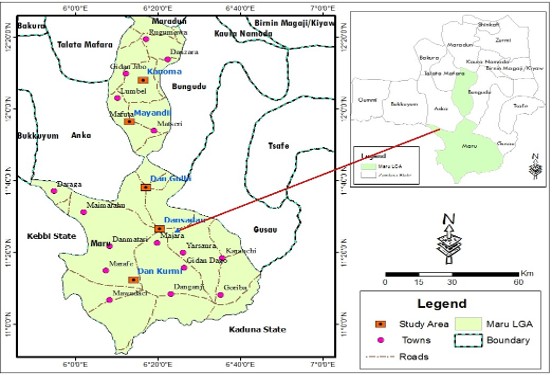
Study Area

Published

2026-10-07

How to Cite

Midala, S. D., Sawa, B. A., Bata, D. A., & Midala, R. D. (2026). Assessing The Socio-Economic Effects of Banditry on Households in Maru LGA, Zamfara State, Nigeria. FUDMA Journal of Humanities, Social Science and Creative Arts, 2(2), 104-116. https://doi.org/10.70882/fujohssaca.2026.v2(2).51

How to Cite

Midala, S. D., Sawa, B. A., Bata, D. A., & Midala, R. D. (2026). Assessing The Socio-Economic Effects of Banditry on Households in Maru LGA, Zamfara State, Nigeria. FUDMA Journal of Humanities, Social Science and Creative Arts, 2(2), 104-116. https://doi.org/10.70882/fujohssaca.2026.v2(2).51