Cyberbullying and Sexting Behaviours among Adolescents in Sub-Saharan Africa: An Integrative Literature Review

Authors

Keywords:

Cyberbullying, Digital behaviour, Sexting, Adolescents, Integrative review, Sub-Saharan Africa

Abstract

The rapid expansion of digital technologies and social media use has increased adolescents’ exposure to online risks, including cyberbullying and sexting. Although these behaviours have become significant public health and social concerns globally, evidence from sub-Saharan Africa remains fragmented despite the region's growing youth population and digital connectivity. This integrative literature review examined the prevalence, forms, intersectionality, determinants, and consequences of cyberbullying and sexting among adolescents in sub-Saharan Africa. An integrative literature review approach was employed to synthesize empirical and theoretical evidence on cyberbullying and sexting among adolescents in sub-Saharan Africa. Relevant literature was retrieved from electronic databases, including Google Scholar, PsycINFO, ProQuest, ResearchGate, and Taylor and Francis Online. The selected studies were critically reviewed to identify patterns and emerging issues. The review revealed that cyberbullying and sexting are prevalent among adolescents across sub-Saharan Africa and are facilitated by increasing access to smartphones, internet services, and social media platforms. Cyberbullying commonly manifests as online harassment, threats, intimidation, public humiliation, exclusion, cyberstalking, and image-based abuse, while sexting occurs in forms such as consensual sexting, non-consensual image sharing, sextortion, and coercive sexual communication. The findings further indicate a strong interrelationship between cyberbullying and sexting, whereby intimate digital content is frequently used for victimization, blackmail, coercion, and public shaming. Cyberbullying and sexting constitute interconnected digital threats with far-reaching implications for the mental health, psychosocial well-being, and educational development of adolescents in sub-Saharan Africa. Addressing these challenges requires coordinated and culturally responsive interventions involving families, schools, communities, policymakers, technology providers, and governments. Strengthening digital literacy, online safety education, mental health support services, and protective policy frameworks is essential for promoting safer digital environments and safeguarding adolescent well-being in the evolving digital age.
Dimensions

Aboagye, R.G., Seidu, A.A., Hagan, J.E. et al. (2021). A multi-country analysis of the prevalence and factors associated with bullying victimisation among in-school adolescents in sub-Saharan Africa: evidence from the global school-based health survey. BMC Psychiatry, 21, 325.

Acquah, E.O., Wilson, M.L, Doku, D.T. (2014). Patterns and correlates for bullying among young adolescents in Ghana. Soc Sci..3(4):827–40.

Ademiluyi, A., Chuqin, L.& Albert. P. (2022). Implications and preventions of cyberbullying and social exclusion in social media: systematic review." JMIR formative research 6(1): e30286.

Ahmad (Ayassrah), A.Y.A.B. Atta, A.A. M. B, Alawawdeh, H.A., Aljundi, N.A. Morshed, A., Dahbour, S.A., & Alqaraleh, M.H. (2023). The Effect of System Quality and User Quality of Information Technology on Internal Audit Effectiveness in Jordan, And the Moderating Effect of Management Support. Applied Mathematics & Information Sciences,17 (5), Article 12. https://dx.doi.org/10.18576/amis/170512

Akanni, O.O., Olashore, A.A., Osasona, S.O. & Uwadiae, E. (2020) Predictors of bullying reported by perpetrators in a sample of senior school students in Benin City, Nigeria. South Afr J Psychiatry.; 26(1):1–8.

Alsawalqa, R. O. (2021). Cyberbullying, social stigma, and self-esteem: the impact of COVID-19 on students from East and Southeast Asia at the University of Jordan. Heliyon, 7(4).

Aune, N.M. (2009). Cyberbullying Graduate Degree/Major: MS School Psychology Research Adviser: Dr. Amy Schlieve MonthlY ear: December 2009 (Doctoral dissertation, University of WisconsinStout)

Barlett, C., & Coyne, S. M. (2014). A meta‐analysis of sex differences in cyber‐bullying behavior: The moderating role of age. Aggressive behavior, 40(5), 474-488.

Barrense-Dias, Y., Berchtold, A., Surís, J.C. & Akre, C. (2017). Sexting and the Definition Issue. J. Adolesc. Health, 61, 544–554.

Barrense-Dias, Y., Surís, J.C. & Akre, C. (2019). When it deviates it becomes harassment, doesn’t it?. A qualitative study on the definition of sexting according to adolescents and young adults, parents, and teachers. Arch. Sex. Behav., 48, 2357–2366.

Beyea, S. C. & Nicoll, L. H. (1998). Writing an integrative review. AORN Journal, 67(4), 877–880. https://doi.org/10.1016/S0001-2092(06)62653-7.

Blumler, J.G. and Katz, E. (1974) The Uses of Mass Communications: Current Perspectives on Gratifications Research. Sage Annual Reviews of Communication Research, 3. https://eric.ed.gov/?id=ED119208

Braun V., Clarke V. (2006). Using thematic analysis in psychology. Qualitative Research in Psychology, 3(2), 77–101. https://doi.org/10.1191/1478088706qp063oa

Campbell, M. A., Whiteford, C., Duncanson, K., Spears, B., Butler, D. & Slee, P. T. (2020). Cyberbullying bystanders: Gender, grade, and actions among primary and secondary school students in Australia. International Journal of Technoethics, 8(1), 44–55.

Casas, J.A., Mónica Ojeda, P.E., Rey, R. D. (2019). Exploring which factors contribute to teens' participation in sexting. Computers in Human Behavior, 100, 60-69, 7475632

Choi, H.J., Mori, C., Van Ouytsel, J., Madigan, S. & Temple, J.R. (2019). Adolescent Sexting Involvement Over 4 Years and Associations With Sexual Activity. J Adolesc Health.;65(6):738-744.

Chudal, R., Tiiri, E., Brunstein Klomek, A., Ong, S.H., Fossum, S., Kaneko, H. & Sourander, A. (2021). “Victimization by traditional bullying and cyberbullying and the combination of these among adolescents in 13 European and Asian countries”. European Child & Adolescent Psychiatry, 1-14.

Cilliers, L. (2021). Perception and Experiences of Cyberbullying Among University Students in Eastern Cape Province, South Africa. The Journal for Transdisciplinary Research in South Africa, 17, (1)a776 https://doi.org/10.4102/td.v17i1.776

Commey, I. T., Amoadu, M., Obeng, P., Okantey, C., Boso, C. M., Agyare, D. F., Druye, A. A., Opoku-Danso, R., Ninnoni, J. P. K., Nsatimba, F., Abraham, S. A., & Hagan, J. E., Jr. (2024). Sexting among College Students in Africa: A Scoping Review of Prevalence, Risk Factors, and Impact. Sexes, 5(3), 285-299. https://doi.org/10.3390/sexes5030022

Cornelius, T. L., Bell, K. M., Kistler, T., & Drouin, M. (2020). Consensual Sexting among College Students: The Interplay of Coercion and Intimate Partner Aggression in Perceived Consequences of Sexting. International Journal of Environmental Research and Public Health, 17(19), 7141. https://doi.org/10.3390/ijerph17197141

Daudu, B. O., Osimen, G. U., & Shuaibu, K. (2023). Cyberbullying and social media: Implications for African digital space. In Combatting Cyberbullying in Digital Media with Artificial Intelligence (pp. 243-253). Chapman and Hall/CRC.

David G, L. SC, Maria PF, H. S. B, & Poco K. (2018). Sexting Rates and Predictors From an Urban Midwest High School. Journal of School Health, 88(6), 423–433. https://doi.org/10.1111/josh.12628

Dodaj, A. & Sesar, K. (2020). Sexting categories. Mediterranean Journal of Clinical Psychology, 8(2).1-26

Drouin, M., & Tobin, E. (2014). Unwanted but consensual sexting among young adults. Relations with attachment and sexual motivations. Computers in Human Behavior, 31, 412-418. https://doi.org/10.1016/j.chb.2013.11.001

Esquivel, F. A., López, I. L. de L. G., & Benavides, A. D. (2023). Emotional impact of bullying and cyberbullying: perceptions and effects on students. Revista Caribeña De Ciencias Sociales, 12(1), 367–383. https://doi.org/10.55905/rcssv12n1-022

Fehintola, V. A. (2025). Social Media, Cyberbullying, and Psychological Adjustment in Disability Contexts. African Journal of Humanities and Contemporary Education Research, 20(1), 183-201. https://doi.org/10.62154/ajhcer.2025.020.01023

Frankel, A.S., Bass, S.B., Patterson, F., Dai, T.& Brown, D. (2018). Sexting, risk behavior, and mental health in adolescents: An examination of 2015 Pennsylvania Youth Risk Behavior Survey data. J. Sch. Health 2018, 88, 190–199.

Gary, W. G., Robin, M. Kowalski, (2022). Cyberbullying via social media and well-being. Current Opinion in Psychology, 45, 101314,ISSN 2352-250X, https://doi.org/10.1016/j.copsyc.2022.101314.

Gassó, A. M., Klettke, B., Agustina, J. R., & Montiel, I. (2019). Sexting, Mental Health, and Victimization Among Adolescents: A Literature Review. International Journal of Environmental Research and Public Health, 16(13), 2364. https://doi.org/10.3390/ijerph16132364

George, M.J.& Odgers, C.L. (2015). Seven fears and the science of how mobile technologies may be influencing adolescents in the digital age. Perspect. Psychol. Sci., 10, 832–851

Gohal, G., Alqassim, A., Eltyeb, E. et al. (2023). Prevalence and related risks of cyberbullying and its effects on adolescent. BMC Psychiatry 23, 39. https://doi.org/10.1186/s12888-023-04542-0

Gámez-Guadix, M., Almendros, C., Borrajo, E. et al.(2015). Prevalence and Association of Sexting and Online Sexual Victimization Among Spanish Adults. Sex Res Soc Policy 12, 145–154 https://doi.org/10.1007/s13178-015-0186-9

Greco, G., Tambolini, R., Ambruosi, P., & Fischetti, F. (2017). Negative effects of smartphone use on physical and technical performance of young footballers. Journal of Physical Education and Sport, 17(4), 2495-2501.

Hamamra, B., Mahamid, F. & Bdier, D. Honor, fear, and coercion: cyberbullying and blackmailing in Palestinian society. Secur J 38, 59 (2025). https://doi.org/10.1057/s41284-025-00509-w

Hu, Y., Clancy, E.M. & Klettke, B. (2023). Understanding the Vicious Cycle: Relationships between Nonconsensual Sexting Behaviours and Cyberbullying Perpetration. Sexes, 4, 155–166. https://doi.org/10.3390/sexes4010013

Huțul, T. D. & Karner-Huțuleac, A. (2022). Sexting: On the border from simple curiosity to ‘Revenge Porn’and the impact of sexual cyberbullying. Cyberbullying in educational context, 121-134.

Jun, W. (2020). “A study on the cause analysis of cyberbullying in Korean adolescents. International Journal of Environmental Research and Public Health, 17(13): 4648

Kibe, L., Kwanya, T., Kogos, A., Ogolla, E., & Onsare, C. (2022). Types of Cyberbullying Experienced on Facebook by Undergraduate Students in Kenyan Universities. Journal of Cyberspace Studies, 6(2), 149-182. https://doi.org/10.22059/jcss.2022.345644. 1076

Korenis P & Billick, S.B. (2014). Forensic implications: adolescent sexting and cyberbullying. Psychiatr Q. 85(1):97-101. https://doi.org/10.1007/s11126-013-9277-z. PMID: 24129662.

Kowalski, R.M., Giumetti, G.W., Schroeder, A.N.& Lattanner, M.R. (2014).Bullying in the digital age: a critical review and meta-analysis of cyberbullying research among youth. Psychol Bull., 140(4):1073-1137. https://doi.org/10.1037/a0035618

Kubwalo H.W., Muula, A.S., Siziya, S., Pasupulati, S.& Rudatsikira, E. (2013) Prevalence and correlates of being bullied among in-school adolescents in Malawi: results from the 2009 global school-based health survey. Malawi Med J.;25(1):12–4.

Krešić Ćorić, M., & Kaštelan, A. (2020). Bullying through the internet-cyberbullying. Psychiatria Danubina, 32(suppl. 2), 269-272.

Kumari, N. & Srivastava, S. (2017). Effects of sexting on self-esteem and body-image among teenagers. Journal of Humanities And Social Science, 22(11), 38-43.

Kwanya, T. (2022). “Mixed Methods and Quality of Postgraduate Research: A Kenyan Perspective”. Handbook of Research on Mixed Methods Research in Information Science, IGI Global: 147- 172.

Liakopoulos, D. (2020). Cyberbullying and sexting. New open frontiers of criminal law: The case of Canada and Australia.

Machimbarrena, J. M., Calvete, E., Fernández-González, L., Álvarez-Bardón, A., Álvarez-Fernández, L., & González-Cabrera, J. (2018). Internet Risks: An Overview of Victimization in Cyberbullying, Cyber Dating Abuse, Sexting, Online Grooming and Problematic Internet Use. International Journal of Environmental Research and Public Health, 15(11), 2471. https://doi.org/10.3390/ijerph15112471

Malesa, K. J., & Sekgobela, T. (2025). The destructive consequence of cyberbullying on the mental health of learners in South Africa. International Journal of Business Ecosystem & Strategy (2687-2293), 7(5), 428-434.

González, M.B., Reynoso, M.T., Barquín, S. M. (2025). Cyberbullying in high school and university: Description, comparison, and zrassociations between behaviors in victims and aggressors. Interacciones, 11, e445. https://dx.doi.org/10.24016/2025.v11.445

Madigan, S., Ly, A., Rash, C.L & Van Ouytsel, J. & Temple, J.R. (2018). Prevalence of multiple forms of sexting behavior among youth: a systematic review and meta-analysis. JAMA Pediatr,172(4):327-335

Makori, A., & Agufana, P. B. (2020). Cyber bulling among learners in higher educational institutions in sub-saharan africa: examining challenges and possible mitigations.

McGlynn, C.. McGlynn, E. & Rackley, R. H. (2017). Beyond “revenge porn”: The continuum of image-based sexual abuse Feminist. Legal Studies, 25, 25-46

Molla-Esparza, C., Losilla, J. M., & López-González, E. (2023). Sexting prevalence in high-school students depends on the addressee, media format, explicitness of sexts, and gender. Behaviour & Information Technology, 42(16), 2852–2870. https://doi.org/10.1080/0144929X.2022.2150563

Morelli, M., Bianchi, D., Baiocco, R., Pezzuti, L., & Sapienza, A. C. (2016). Sexting, psychological distress and dating violence among adolescents and young adults. Psicothema, 28(2), 137-142.

Motswi, E., & Mashegoane, S. (2017). The role of sex in the prevalence rates and psychological consequences of cyberbullying among learners in the Limpopo Province, South Africa. Gender and Behaviour, 15(3), 9808-9817.

Mori, C., Cooke, J.E., Temple, J.R. et al. The Prevalence of Sexting Behaviors Among Emerging Adults: A Meta-Analysis. Arch Sex Behav 49, 1103–1119 (2020). https://doi.org/10.1007/s10508-020-01656-4

Morelli, M., Urbini, F., Bianchi, D., Baiocco, R., Cattelino, E., Laghi, F…, A. Chirumbolo (2021). The relationship between dark triad personality traits and sexting behaviors among adolescents and young adults across 11 countries. International Journal of Environmental Research and Public Health, 18 (5), 2526-2550

Mussap, A.J., Clancy, E.M. & Klettke, B. Attitudes and Beliefs Associated with Cyberbullying and Non-Consensual Sexting in Cisgender and Transgender Adults. Gend. Issues 40, 65–85 (2023). https://doi.org/10.1007/s12147-022-09304-y

Ndebele, C., & Msiza, D. (2014). An Analysis of the Prevalence and Effects of Bullying at Remote Rural Schools in Eastern Cape Province of South Africa: Lessons for School Principals. Student Tribes Tribal, 12 (1)113-124.

Ndibalema, P.M., 2024. The growth of cyberbullying among youth in higher learning institutions: a bibliometric analysis. Educational Dimension [Online], 10,143–166.

Nkwanyana, B. P. (2025). Psycho-social effects of cyberbullying in selected secondary schools, KwaZulu-Natal, South Africa. Interdisciplinary Journal of Education Research, 7(s1), a12. https://doi.org/10.38140/ijer-2025.vol7.s1.12

Notar, C.E.; Padgett, S. & Roden, J. (2013). “Cyberbullying: A review of the literature”. Universal Journal of Educational Research, 1(1): 1-9.

Ojeda, M., Del-Rey, R., Walrave, M., & Vandebosch, H. (2020). Sexting in adolescents: Prevalence and behaviours. Comunicar.-Place of publication unknown, 28(64), 9-19.

Ojewola, F. O. & Akinduyo, T. E. (2019). Distractive impact of mobile phone usage among Adekunle Ajasin University undergraduates in Ondo State, Nigeria Global Science Research Journals, 4(1), 423-427

Otanga, H. (2024). Impulsivity and sexting. In The Psychology and Neuroscience of Impulsivity (pp. 47-64). Academic Press.

Patel, U. & Roesch, R. (2022). The prevalence of technology-facilitated sexual violence: A meta-analysis and systematic review. Trauma, Violence, & Abuse, 23 (2) (2022) 428-443

Payne, A. (2015). The nature and impact of cyberbullying among South African youth: an explanatory analysis.

Peled, Y. (2019). “Cyberbullying and its influence on academic, social, and emotion al development of undergraduate students”. Heliyon, 5(3): e01393

Pichel, R., Feijóo, S., Isorna, M., Varela, J., & Rial, A. (2022). Analysis of the relationship between school bullying, cyberbullying, and substance use. Children and youth services review, 134, 106369.

Ragona, A,, Mesce, M., Cimino, S.& Cerniglia, L. (2023). Motivations, Behaviors and Expectancies of Sexting: The Role of Defensive Strategies and Social Media Addiction in a Sample of Adolescents. Int J Environ Res Public Health,20(3):1805. https://doi.org/10.3390/ijerph20031805

Ramjan, L. M., Salamonson, Y., Batt, S., Kong, A., McGrath, B., Richards, G., & Crawford, R. (2021). The negative impact of smartphone usage on nursing students: An integrative literature review. Nurse education today, 102, 104909.

Ringrose, J., Harvey, L., Gill, R., & Livingstone, S. (2013). Teen girls, sexual double standards and ‘sexting’: Gendered value in digital image exchange. Feminist Theory, 14(3), 305–323.

Rodríguez-Castro, Y., Rosana Martínez-Román, P. A., Alba, A., & María, V. C. (2021). Intimate partner cyberstalking, sexism, pornography, and sexting in adolescents: New challenges for sex education. International Journal of Environmental Research and Public Health, 18: 2181

Rodríguez, J. M. R., Berral-Ortiz, B., Maldonado, J. J. V., & Menéndez, A. M. (2025). Impact of Sexting, Inappropriate Content Sharing, and Cyberbullying on Youth Education. In Students' Online Risk Behaviors: Psychoeducational Predictors, Outcomes, and Prevention (pp. 269-292). IGI Global Scientific Publishing.

Samanta, P. (2025). Cyberbullying and Online Aggression: Patterns, Predictors, and Prevention. Research Journal in Psychology and Behavioral Studies, 2(1), 25–37. https://doi.org/10.61424/rjpbs.v2i1.557

Sharma, D., Kishore, J., Sharma, N., & Duggal, M. (2017). Aggression in schools: cyberbullying and gender issues. Asian journal of psychiatry, 29, 142-145.

Moses Sichach 15-1605 Uses and Gratifications theory - Background, History and Limitations This mid semester assignment has been submitted in fullfilment to the partial requirements for the course Graduate Research Writing (GRW 613X) Submitted to Dr. Daniel Omondi Department of Strategic and Organisational Communication 17th November 2023

Singh, M. K. K., & Samah, N. A. (2018). Impact of smartphone: A review on positive and negative effects on students. Asian Social Science, 14(11), 83-89.

Sinthumule, D. A., & Ngonyama, T. T. (2022). Cyberbullying in public schools: Causes and effects on learner academic performance. Journal of Educational Studies, 21(4), 52-70.

Soto, A. M., Lopez-del Burgo, C., Albertos, A., & Ibabe, I. (2024). Cyber dating abuse in adolescents: Myths of romantic love, sexting practices and bullying. Computers in Human Behavior, 150, 108001.

Sparks, B., Stephens, S., & Trendell, S. (2023). Image-based sexual abuse: Victim-perpetrator overlap and risk-related correlates of coerced sexting, non-consensual dissemination of intimate images, and cyberflashing. Computers in Human Behavior, 148, 107879.

Thomas, S. (2018). What should I do? Young women’s reported dilemmas with nude photographs. Journal of Sexuality Research and Social Policy, 15, 192–207

Tokunaga, R.S. (2010). Following You Home from School: A Critical Review and synthesis of research on cyberbullying victimization. Comput. Hum. Behav., 26, 277–287.

Toronto, C.E. (2020). Overview of the Integrative Review. In: Toronto, C., Remington, R. (eds) A Step-by-Step Guide to Conducting an Integrative Review. Springer, Cham. https://doi.org/10.1007/978-3-030-37504-1_1

Vanden, A M., Campbell, S.W., Eggermont, S., & Roe, K . (2014). Sexting, Mobile Porn Use, and Peer Group Dynamics: Boys’ and Girls’ Self-Perceived Popularity, Need for Popularity, and Perceived Peer Pressure. Media Psychology, 17(1), 6–33. https://doi.org/10.1080/15213269.2013.801725

Van Ouytsel, J., Lu, Y., Ponnet, K., Walrave, M., & Temple, J. R. (2019). Longitudinal associations between sexting, cyberbullying, and bullying among adolescents: Cross-lagged panel analysis. Journal of Adolescence, 73, 36-41

Walker, C.M.; Beth R.S. & Steven, K. (2011). “An exploratory study of cyberbullying with undergraduate university students”.

Wang, M. J., Yogeeswaran, K., Andrews, N. P., Hawi, D. R., & Sibley, C. G. (2019). How common is cyberbullying among adults? Exploring gender, ethnic, and age differences in the prevalence of cyberbullying. Cyberpsychology, Behavior, and Social Networking, 22(11), 736-741.

West et al. (2014). Sexting among peruvian adolescents. BMC Public Health, 14:811

World Bank (2016). World development report 2016: digital dividends. World Bank Publications, the World Bank Group

Young, K. & Govender, C. (2018). “A comparison of gender, age, grade, and experiences of authoritarian parenting amongst traditional and cyberbullying perpetrators”. South African Journal of Education, 38(Supplement 1): s1-s11

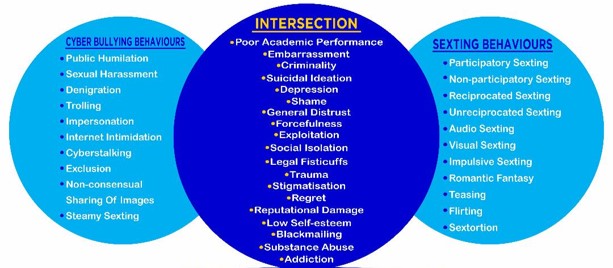
Diagram showing Intersection of Cyberbullying and Sexting

Published

2026-07-15

How to Cite

Akinduyo, T. E. (2026). Cyberbullying and Sexting Behaviours among Adolescents in Sub-Saharan Africa: An Integrative Literature Review. FUDMA Journal of Humanities, Social Science and Creative Arts, 2(2), 47-59. https://doi.org/10.70882/fujohssaca.2026.v2(2).46

How to Cite

Akinduyo, T. E. (2026). Cyberbullying and Sexting Behaviours among Adolescents in Sub-Saharan Africa: An Integrative Literature Review. FUDMA Journal of Humanities, Social Science and Creative Arts, 2(2), 47-59. https://doi.org/10.70882/fujohssaca.2026.v2(2).46