Urbanisation and Environmental Sustainability in Nigeria: The Moderating Role of Institutional Quality
Keywords:
Institutional quality, Urbanisation, Environmental degradation, Carbon dioxide, Ecological footprintAbstract
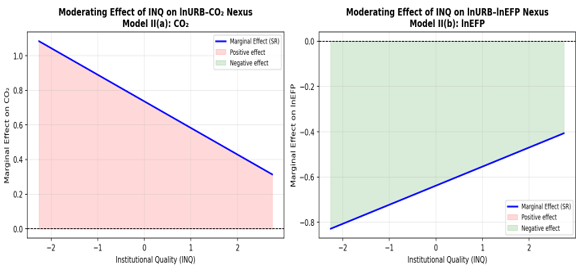
The study examines the moderating effects of institutional quality on the relationship between urbanisation and environmental degradation in Nigeria during 1981 to 2024. Although urbanisation is being well documented as a source of environmental pressures in developing economies, the institutional channels by which governance quality can exacerbate or mitigate the environmental cost have not been well investigated, especially in the context of Nigeria's policies. This paper considers the conditional impact of urbanisation on environmental degradation using ARDL framework and an urbanisation–institutional quality interaction term, supplemented by Fully Modified Ordinary Least Squares and Dynamic Ordinary Least Squares long-run estimators for robustness using dual complementary indicators: carbon dioxide (CO₂) emissions and ecological footprint. Institutional quality is a composite index based on six dimensions of World Governance Indicators using Principal Component Analysis. Findings demonstrate that institutional environment plays an important moderating role: under good governance, environmental pressures from urbanisation are much lower, and vice versa. Findings demonstrate that institutional quality plays a significant moderating role: the long-run urbanisation elasticity of CO₂ emissions declines from approximately 1.01 under weak governance to 0.64 under optimal institutional conditions (threshold INQ∗ ≈ 4.79), while institutional quality independently reduces CO₂ by 0.277 and ecological footprint by 0.522 in the long run. The threshold indicates the minimum institutional standards required to achieve governance benefits in environmental outcomes. This study has policy implications, specifically for Nigeria's environmental governance planning, especially for strengthening NESREA and implementation of the Climate Change Act 2021, in line with SDG 13 and SDG 16.
Published
How to Cite
Issue
Section
Copyright (c) 2026 Sesan Sunday Abere, Mary Oyindamola Oyekanmi (Author)

This work is licensed under a Creative Commons Attribution-NonCommercial 4.0 International License.
- Attribution — You must give appropriate credit, provide a link to the license, and indicate if changes were made. You may do so in any reasonable manner, but not in any way that suggests the licensor endorses you or your use.
- Non-Commercial — You may not use the material for commercial purposes.
- No additional restrictions — You may not apply legal terms or technological measures that legally restrict others from doing anything the license permits.