Exploration of Traditional Menstrual Hygiene Management Practices Among Women in Selected Rural Communities of Katsina State, Nigeria
Keywords:
Menstrual Hygiene Management, Period Shaming, Period Poverty, Rural Women, Traditional PracticesAbstract
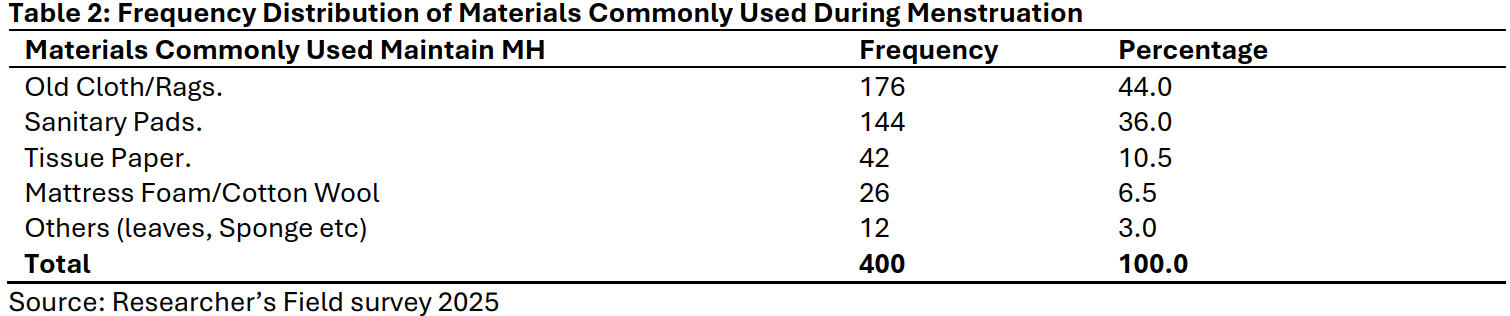
This study was undertaken in response to growing concerns about period poverty and its implications for women’s reproductive health and personal dignity. The study aimed to explore traditional menstrual hygiene practices among women of reproductive age. A cross-sectional design was adopted. The study population comprised 400 women aged 15–49 years residing in selected rural communities of Katsina State. A multi-stage sampling technique was employed, involving the use of purposive sampling technique to select five culturally diverse and accessible Local Government Areas. Convenience sampling was also used to select eligible and consenting participants. Data were collected using structured questionnaire. Analysis was conducted using SPSS version 25. Descriptive and inferential statistics were used to analysed and present data. Findings revealed a high reliance on old cloths and rags compared to sanitary pads. Women were found to indulge in use of herbs and other traditional methods to manage menstrual health. Also, there is a strong association between marital status and cost of pads. The findings also shows significant relationship between types of menstrual material used and exposure to reproductive health challenges. The study concluded that the persistence of period poverty and reliance on unconventional materials and traditional methods to manage menstruation in rural Katsina State is shaped by economic hardship, sociocultural norms, and infrastructural limitations. The study thus recommends that coordinated efforts is required to address these challenges; government and NGO partnerships will provide subsidized or free menstrual products, there should be promotion of safe reusable alternatives, and the integration of menstrual hygiene education into schools and primary healthcare services.
Published
How to Cite
Issue
Section
Copyright (c) 2026 Aliyu Dalhat Adamu, Anifat AbdurRaheem, Suleiman Amali, Moses Msughter Ilim (Author)

This work is licensed under a Creative Commons Attribution-NonCommercial 4.0 International License.
- Attribution — You must give appropriate credit, provide a link to the license, and indicate if changes were made. You may do so in any reasonable manner, but not in any way that suggests the licensor endorses you or your use.
- Non-Commercial — You may not use the material for commercial purposes.
- No additional restrictions — You may not apply legal terms or technological measures that legally restrict others from doing anything the license permits.