Farmers-Herders’ Conflict and Its Impact on Health and Educational Well-being of Women in Plateau State, Nigeria
Keywords:
Conflicts, Farmers, Herders, Health and Educational WellbeingAbstract
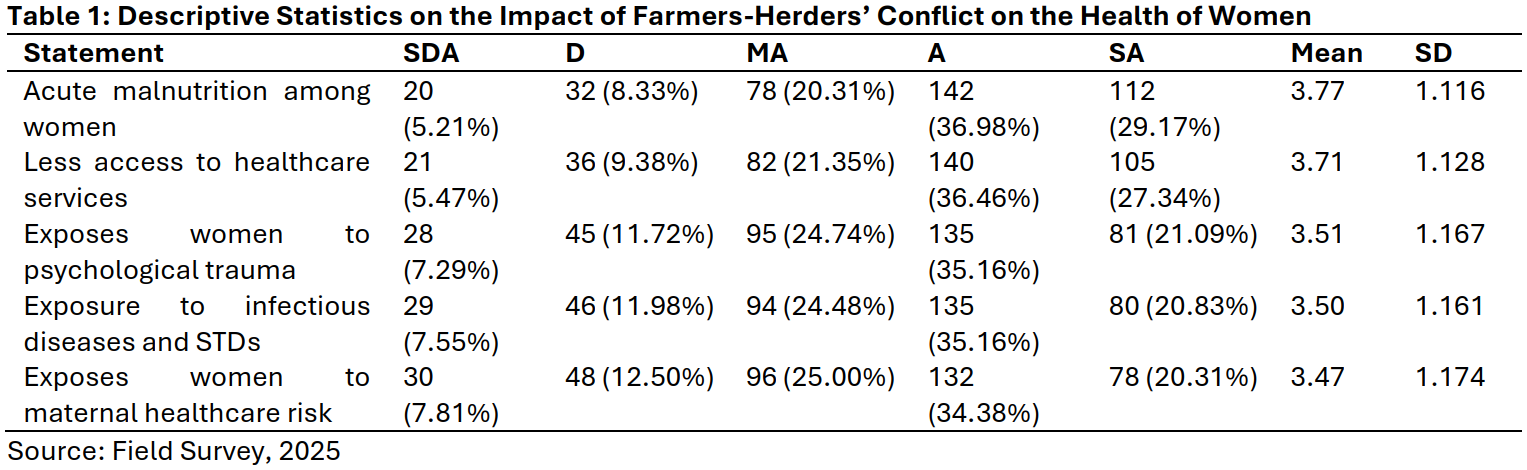
The persistent conflict between farmers and herders in Nigeria, in general and Plateau State in particular, has evolved into a major security and humanitarian crisis with profound socio-economic consequences. Women, who are central to agricultural production, household welfare, and community stability, have become the most affected group due to their limited access to resources, increased exposure to violence and loss of economic and social opportunities. Thus, this study examines the impact of farmers-herders’ conflict on the health and educational well-being of women in six conflict-affected Local Government Areas in Plateau State. They included Barkin Ladi, Bassa, Bokkos, Mangu, Riyom, and Wase. The study was anchored on Human Capital Theory, which emphasizes investment in education, health and skills as key drivers of productivity, wellbeing and sustainable development. This study adopted a descriptive survey research design in the collection and analysis of data using a structured questionnaire. A total of 384 responses were analyzed using descriptive statistics and simple regression analysis. The findings revealed that farmers-herders’ conflict significantly undermines women’s health, leading to malnutrition, restricted access to healthcare services, psychological trauma, heightened exposure to infectious diseases, and increased maternal health risks among women. More so, it was made obvious that the conflict leads to a diminished teaching workforce, destruction and closure of schools, increased dropout rates among women, and erodes access to quality education. Therefore, the conflict between farmers and herders diminishes the health and educational well-being of women. The study recommends, among others, that the government and humanitarian agencies (NGOs) should prioritize the establishment of mobile healthcare services in conflict-prone areas and vocational training centres for women and girls for skills acquisition.
Published
How to Cite
Issue
Section
Copyright (c) 2026 Gideon Sambo Bauda, Usman Alhaji Yusuf (Author)

This work is licensed under a Creative Commons Attribution-NonCommercial 4.0 International License.
- Attribution — You must give appropriate credit, provide a link to the license, and indicate if changes were made. You may do so in any reasonable manner, but not in any way that suggests the licensor endorses you or your use.
- Non-Commercial — You may not use the material for commercial purposes.
- No additional restrictions — You may not apply legal terms or technological measures that legally restrict others from doing anything the license permits.